Thursday, November 23, 2017

Are Foreigners Financing America?

Like the proverbial sky falling on the head fear, the financial community is perennially worried that foreigners will stop financing America's current account deficit--specifically, that they will stop buying Treasury debt and start selling it.

People think of 'our dependence on foreigner investors' as if America were perched on a high tree trunk and foreign investors were armed with saws, ready to cutoff the limb. The analogy is not bad, except that it has the actors switched. The question is not, "What will happen to us if foreigners stop buying our debt?" but, "What will happen to other countries if they can no longer sell us their goods?"

Two fallacies underlie the worry that we will be abandoned by foreign investors. The first is that foreigners somehow bring money to our markets that otherwise would not be there, and the second is that they can make money disappear from our economy. Last time I checked, Treasury debt was denominated in dollars, and the United States was obligated to make interest and principal payments in dollars. I also note that the Federal Reserve, not international investors, determines the US money supply. Only if foreigners actions made the Fed compelled to support the dollar through higher interest rates would domestic credit conditions tighten.

Foreign investors can affect currency markets, but they can only frighten or briefly disrupt the Treasury market. Suppose a foreign investor becomes fed up with financing America's debts, so he sells all his US government bonds and converts the proceeds to euro, yen, or gold. Unless he does business with Houdini, the dollars do not disappear or magically turn into gold, yen, or euro. Now someone else owns the dollars and what will they do with them? Dollars pulled out of the US asset markets by foreigners wishing to repatriate do not vanish but instead keep flowing back to the same markets.

Widespread selling of dollar denominated assets could put great pressure on the dollar's exchange rate. Although the supply of dollars is not changed, the bond market could sell off because it believes that the weak dollar will cause inflation, forcing the Fed to tighten. But these are effects on perception. To be sure, such misplaced perceptions could cause momentary turmoil in the bond market, but economic reality would soon bring it back to balance.

A drop in the US dollar would have some effect on US inflation. However, the impact is likely to be muted. First, services, which are domestically produced, constitute the bulk of the CPI. Second, even the link between import prices and domestic goods prices is hardly tight. As the chart below shows, when the dollar appreciates, domestic consumer prices rise relative to import prices and vice versa. In effect, there appears to be some relative "price stickiness." Another way to look at it is that, when the dollar appreciates, US consumers do not enjoy the full benefits and vice versa. Curiously, the relationship seems to have completely broken in recent years--note that the surge in the dollar in 2014-2016 had no discernible impact on the relative prices.


Which brings us to the bigger question. Who is dependent on whom? Foreign countries are not buying Treasury securities out of munificence. Nor is their buying of Treasury securities 'financing' anything. Rather they acquire dollars when they agree to accept dollars are payment for goods they sell in the US. How they allocate the thus acquired dollars to various dollar-denominated assets is a portfolio choice not a financing decision. Of course, they could decide not to accept dollars as payment for goods. But then where are they going to sell their goods to keep their factories running? As long as the rest of the world has not figured out a way to generate domestic demand sufficient to keep its domestic supply gainfully employed, the world will remain dependent on the US as the buyer of last resort.

Saturday, November 18, 2017

The Decline in Productivity: It's the Demand, Stupid

Labor productivity in this expansion has been abysmal, with the last five years looking especially dreadful. Multifactor productivity has been slightly better, although it too has been anemic. Tyler Cowen thinks productivity is weak because Americans have become lazy and complacent. He has written a whole book about it. This would be not so egregious if productivity had also not dropped in the still-striving emerging markets. Maybe they too are becoming fat and happy. We all need to go back to the happy days of sweatshops perhaps to get our productivity juices flowing! leaving snark aside, most mainstream economists are puzzled. On the other hand, economists who think demand matters clearly recognize that the productivity slowdown has a lot to do with a persistently low-pressure economy. See, this EPI paper by Josh Bivens for an excellent exposition of the demand side view.


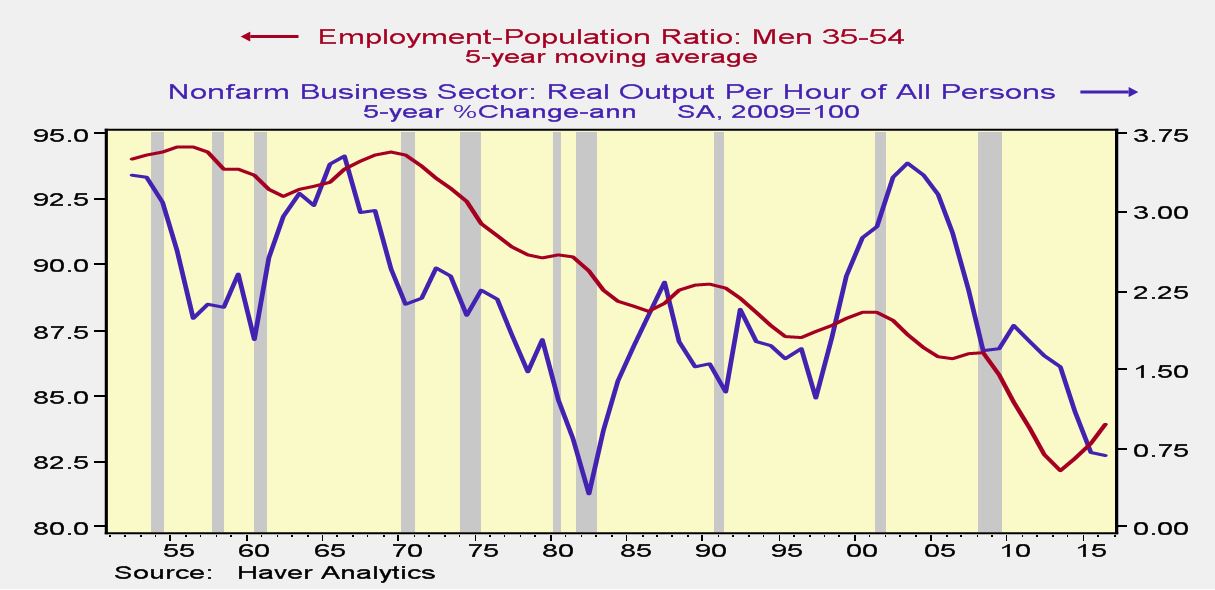
While I broadly agree with Josh Bivens, I have some disagreements about the causal factors. Bivens thinks that weak investment in new technology is hurting labor productivity, and tepid aggregate demand is keeping investment subdued. I agree on the latter point (see my exposition here). On the former point, I think Bivens understates his case by ignoring the direct impact of robust demand on productivity--the so-called Kaldor-Verdoorn law. The basic idea is that there are increasing returns to scale. I also think that a high-pressure economy that stretches its resources stokes people to find ways to use those resources more efficiently, raising productivity. There are two ways to see how productivity is related to utilization of resources. First, the trend in employment-population ratio for prime-age males has generally moved with the trend in productivity. (I have excluded 25-34 year-olds because more men are going to grad school. In any case, including them will not change the picture.) I don't think society has progressed to the point where 18% of prime-age men are now stay-at-home dads. Even if they are, it is likely because the prospects of a good job are poor and the cost of baby-sitting exceeds the jobs they might get. Essentially, this is a good proxy for labor market tightness in a secular sense.


Second, economywide capacity utilization has been weak on a secular basis (see my FT Alphaville post linked above). Business sector value added scaled to the capital stock--a proxy for economywide capcity utilization--co-moves with productivity, suggesting that utilizing existing capacity fully would increase productivity.


Bivens focuses on business sector investment as the culprit behind the slowdown in productivity. I want to focus on something that is in the hands of policymakers, government investment. Government investment is, surprise, closely related to productivity. We know that any causality has to run from the former to the latter because government decisions to invest are hardly driven by productivity in the overall economy! In particular, government investment in R&D has collapsed.


Friday, November 10, 2017

Saving, Investment, Loanable Funds, Paradox of Thrift

Whether saving funds investment and whether increased saving leads to greater investment is a debate that is as old as macroeconomics, and I have no illusions that I am going to settle the debate or change anyone's mind. In my opinion, there are two sources of problems. First is the implicit assumption that the economy is operating under full employment of resources, which underlies most classical, neoclassical, and Austrian analysis.  are major issues most of the problems arise from conflating real and financial flows. Before I begin, I would encourage you to read these two pieces that cover a lot of ground in the debate:


First, some clarifications. Saving is a verb that refers to an act, whereas savings is a noun that refers to a stock.
I am going to start with a rudimentary economy and show that even here increased saving does not automatically translate into increased investment. Take Robinson Crusoe (RC) living on an island and grows corn, which is both the consumption and the investment good. Crusoe grows 100 bushels of corn every period and saves up 20 bushels for seed corn (investment).  Here his saving (giving up consumption) is clearly needed for and leads to higher investment. Note that in such an economy, there is no scope for involuntary unemployment. Mainstream economic theories are fine in such cases.

Let us tweak this example a little bit and see what happens if we introduce a little complexity. RC now works for RC Inc, owned fully by RC of course. RC Inc has a capital of 20 bushels of corn (representing RC's past savings, not saving!), worth $20. In addition, there is an RC Bank. RC Inc goes to RC Bank and gets a loan of $80--created out of thin air. RC Inc now hires RC for $80 for one 8-hour day. At the end of the period, RC Inc. sells RC 80 bushels of corn for $80, repays $80, and reinvests 20 bushels of corn. One fine day, RC reads Aesop's fable about the Ant and the Grasshopper and decides to save $20 instead of spending it all. RC Inc now gets back only $60 and has a problem repaying the $80 loan! Note that RC's bank balance is now $20 and RC Inc has an overdue loan of $20. RC Inc has now 40 bushels of corn and judges that RC's demand is only 60 bushels. Given the 12 bushel seed corn needed to sustain 60 bushel net output, RC Inc figures that the next day only 8 bushels of corn need to be planted and he needs RC's labor services only for 3.2 hours. RC comes to work and finds he can only make $32. Paradox of thrift.

Some (especially monetarists and their modern day reincarnations) would argue that this is hoarding of money not paradox of thrift, that desire to save in the form of money is the problem not desire to save per se. Needless to monetarists then go haywire trying to get people to save in real stuff, which gets us a Frankenstein monster. There are two separate decisions that are conflated.First is the decision to forego consumption. The second is a portfolio decision of how to allocate the savings. In order to see how this works, we are going to introduce financial instruments in addition to money. RC Inc issues 20 shares each worth $1--essentially, RC is now owner of public company instead of being a sole proprietor. When RC decides to save $20, he is not necessarily deciding to increase his money balance. He now has a portfolio of $20 in money and $20 in stocks and a portfolio decision to make. He may decide to buy stocks for $20. RC Inc makes a rights issue of one for one. The money now gets transferred from RC's bank account to RC Inc's bank account--there is no hoarding. RC has now 40 shares. RC Inc uses the proceeds to pay back the overdue loan but he is still faced with lower demand. So, he cuts back RC's hours. Paradox of thrift still holds. One difference between the previous example and the present one is that RC Inc is not facing default.

Let us go back to the RC world without all the financial complications but add a new capital good. RC figures that a seed spreader would make his job easier. He now decides to build a spreader. If RC were working full time on growing corn, then the investment in spreader will come at the cost of current production of corn. So, RC has to "save" in the sense of reducing his corn consumption (or having saved up corn in the past) in order to set aside time for investing in the spreader. Once again, we come back to the full employment of resources issue. If RC is not fully employed, the investment in the spreader creates its own saving. Furthermore, saving corn will not automatically create the spreader.

Needless to say the modern world of financial capitalism is incredibly complex and the chasm between saving and investment decisions is wide. Let us go back to saving without hoarding. If people decide to increase their saving while at the same time become increasingly bullish about the stock market, stocks can get bid up and financing for investment can become cheap and readily available. Mainstream economists think that this influence will eventually lead to higher investment short-circuiting the paradox of thrift. However, history shows that investment is demand-led and that business investment decisions are relatively impervious to changes in the discount rate. Moreover, there have been a slew of papers in recent years showing that investment has been much weaker than the Q-ratio suggests. So, one can simultaneously have a boom in asset prices and weak investment--paradox of thrift without hoarding. Redolent of something we have lived through?


Thursday, October 26, 2017

About that Great Moderation

The Great Recession was supposed to have buried the triumphalism about the Great Moderation. Alas! As the Great Recession recedes into the past, Great Moderation self-patting is coming back. Nothing could be worse for the future of the global economy than a return to status quo policy framework that has brought so much grief over the past decade.

Broadly, there are three problems with the Great Moderation thesis:

1. To the extent there was a Great Moderation, it purchased lower volatility for a marked worsening in skew. In essence, to take analogy from ecology: in curbing brush fires policymakers have created greater potential for forest fires.

2. A substantial portion of the decline in volatility has to do with developments for which policy can hardly take credit. The global economy, and especially developed economies have increasingly shifted away from good to services. Business cycles are inherently about overproduction of stuff. Secondly, even in the goods producing part of the economy, better inventory management has eliminated the wild inventory swings of cycles past.

3. In the US context, a significant proportion of the dampening of volatility is an artefact of data collection, processing, and massaging.

Great Moderation or Worsening Skew?

The Great Moderation's claim rests on having delivered lower volatility in GDP and inflation. I going to dismiss the lower volatility in inflation because I don't think there are any great benefits to lower inflation volatility. The supposed benefits of stable inflation: 1) low cost of capital and 2) lower relative price distortion are both vastly overestimated. See Sharpe and Suarez  and Nakamura and Steinsson.

As the table below shows, during the Great Moderation era, standard deviation of quarterly change in GDP declined considerably compared with the earlier postwar period. However, note that the Skew has worsened, becoming markedly negative. A negative skew means that steep declines are more likely than suggested by a normal distribution.


As I have argued in my previous blogpost, the desire to smoothen fluctuations has led to increasing financial fragility. The recovery from each of the past three recessions has been sluggish. Although it is fashionable to dismiss the 2001 recession as mild one--employment fell for the longest period and took the longest to recover the previous peak until the 2007-2009 recession. Also, the secular decline in labor force participation among prime age workers was triggered by the 2001 recession.

Financial fragility apart, the Great Moderation era has also generally been associated with prolonged periods of slack in the labor market. Note that the unemployment rate has been above NAIRU for the majority of this period compared with the previous era. Thus, stability in inflation may well have been purchased by keeping the labor market perennially weak, in which case the low overall GDP growth during this era must also be chalked to Great Moderation policies rather than other forces that apologists are wont to do.

 
Increasing Shift to Services

One of the major reasons for lower volatility has nothing to do with great macro policies. The global economy has shifted increasingly to services--a sector that is inherently less volatile than the goods-producing sector. Moreover, inventory investment, which used to account for a significant [art of goods sector volatility pre 1980, has come down thanks to better inventory management practices, which, too, has nothing to do with better macro policies.


It is true that service sector volatility has also declined in the Great Moderation era. However, that decline in volatility has to do with increasing proportion of the services being either not market-determined--eg. healthcare, or imputed services.


Better Data or More Smoothing of Data?

One other factor that has contributed to the lower volatility in recent decades is that the source data has become less volatile--probably reflecting better data collection. data produced by the Bureau of Economic Analysis (BEA) has become significantly smoother than the source data. Consider residential improvements. The source data used to be incredibly volatile, as was the final BEA data (red line below). While the source data has become less volatile, the BEA data has become far less volatile and appears to be an attempt to smooth the source data.


Concluding Remarks

Most people are not aware of the arcane issues in data. I have often found that academic economists working with NIPA data do not fully understand all the issues. Yet, they use the same data to make pronouncements about Great Moderation and suchlike.

There is a strong tendency in some parts of the academia to revisionism--there is big industry attempting to show that the Great Depression was caused by Roosevelt's policies. So, beware. Another couple of years and Great Recession may be seen as just a blip in the vast goodness of the Great Moderation. 

Sunday, October 1, 2017

Socializing Risk is Bedrock of Capitalism

A few days ago I tweeted about capitalism, fiat, gold, and cryptos. Seeing the comments, I realized the topic needed to be dealt with in long form. Essentially, the rise of capitalism has gone hand-in-hand with increasing socialization of risk--and this is not a mere coincidence. Central banking, fiat money, social insurance programs, and countercyclical fiscal policy are all intimately related to the expanded socialization of risk. Whether the greater socialization of risk is a moral/ethical is an impossible question that I don't want to get dragged into. Instead, I want to highlight the implications for investors:

1. Although the socialization of risk has had naysayers right from the beginning, every crisis has led to more, not less, socialization of risk over the past 200 years of western capitalism. Those betting on the ultimate collapse of the system--eg. gold bugs--would do well to remember this.
2. The nature of socialization has changed over the past thirty years--the era of inflation targeting and monetary policy dominance--which has profoundly changed the nature of business cycles and the statistical distribution of market outcomes.

Ha Joon Chang had an excellent op-ed in the Guardian several years ago briefly describing the history of the socialization of risk. Basically, starting with limited liability to deposit insurance, governments have enacted policies that attempt to put a floor on losses suffered by risk takers. In the parlance of finance, there is a government put on risky activity. Over time, the government put has expanded to establishing a floor on economic activity and financial markets. Central banking and automatic fiscal stabilizers are part of the expanded government put. The Gold Standard fundamentally interfered with this socialization by constraining governments' ability act in crises. Unsurprisingly, the Gold Standard fell by the wayside. Since Enlightenment, western countries have operated on the principle that man (woman) is the measure of all things and our job is to make life living on this earth (Orwell). It is our belief in our capacity to arrange our affairs and not leave it to providence that marks the radical departure from pre-Enlightenment. In that light, the gold standard is an anachronism--it denies the idea that human beings collectively can durably manage their affairs.

The moral distaste for socialization that some people have often leads them to the erroneous conclusion that such a system must fail, which is very rooted in a religious worldview. Yet such a view would serve an investor poorly.

Over the past thirty years, the nature of the government involvement has changed from establishing a floor to smoothing fluctuations. We have gone from crisis-fighting to promoting tranquility--that is, from selling a put to reducing vol. The original mandate of central banking was to act as a lender of last resort in financial crises. In the post-war era, it expanded to business cycle management. In the inflation targeting era, it has morphed into promising low volatility. Yet, the attempt to deliver low volatility--unlike the attempts to provide a floor--is self-defeating. By promising low and stable inflation, central banks have encouraged excessive leveraging. Credit investors are basically selling a straddle. If economic activity and inflation crater, they suffer losses. On the other hand, if economic activity and inflation are too hot they stand to lose as well, if not on an absolute basis at least on a relative basis. (If economic activity is strong but inflation is contained, then credit investors don't lose on an absolute basis but they fall behind equity investors.) Unsurprisingly, the inflation targeting era has witnessed explosive growth in private sector debt. Ironically, the real beneficiaries are equity investors and government bond investors. Credit investors are effectively selling a put option to the borrowers (equity holders). Lower the premium charged by credit investors, the cheaper the cost of a put for equity investors. Notwithstanding the promises of central bankers, there is a strong human tendency to overpay for lottery like payouts, which is why equity investors are loathe to give dilute their stake. Inflation targeting has made it only easier for equity holders to indulge in their biases.

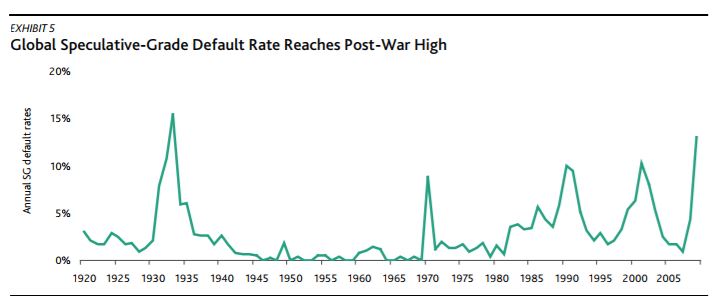
Meanwhile, the explosive growth in private sector debt makes the financial system unstable and prone to deflationary bias. Even as volatility of economic activity and inflation has gone down, the skew in financial markets has actually worsened in the past thirty years. (I would argue that the skew in economic activity has also worsened but it is harder to present strong statistical evidence.) Take S&P as reported earnings. Earnings declines during recessions have become progressively worse. The same with corporate bond defaults. As a result, each crisis has accentuated safe asset demand and forced the Fed lower and lower, helping T-bond investors.


As Minsky said, stability leads to instability. Ashwin Parameswaran used to maintain a terrific blog, Macroresilience, He has argued that policy should aim for resilience (which I like much better than the notion of anti-fragile) not stability. Meanwhile, stability is leading to rebirth of the CDO market.


Monday, September 25, 2017

Why India Needs a Boost from Fiscal and Monetary Policies

Amid growing discontent about the economy--corroborated by my impressionistic view based on Twitterati, most of whom are favorably disposed to the Modi government--a few prominent economists have come out strongly against any short-term fiscal boost. Some have predictably called for more "reforms." Let me state categorically, no amount of reforms will kickstart the private sector quickly. Corporate debt loads are still high, capacity utilization low, and banks are hobbled by NPAs. Businesses invest when they swamped with demand and credit is easily available. Of course, reforms help speed up investment when businesses are eager to invest, but they are a distinctly secondary condition. The famous 1991 reforms started soon after I joined ICICI in 1991. There was no magical pickup in capex. The new project pipeline was practically dry for the next several months. Capex did not meaningfully pickup until 1993-94.

Reforms mantra at this juncture is like the expansionary fiscal consolidation snake oil that was sold during the early stages of the European sovereign debt crisis. The idea was that government austerity and spending cutback could somehow be miraculously lead to faster economic growth. If this sounds too good to be true, it is. Essentially, it ignored the simple math of balance sheet constraints. if European governments were going to consolidate, that is run surpluses and bring down their debt, elementary accounting would imply that some other sector(s)--households, firms, or the rest of the world--had to run a corresponding financial deficit. Given the high levels of private sector debt in many of the beleaguered European countries at that time (excessive household debt among other things had caused the European crisis) and a global economy in which every country was bent on increasing its trade surplus, expansionary fiscal consolidation was an oxymoron.

India's situation is less parlous than Europe's in 2010-11, but to expect the corporate sector to lead to a robust acceleration in growth belies common sense. India's corporate debt-to-GDP appears low in comparison to some other countries (chart 1), but this is misleading. Ideally, corporate debt should be scaled to the sector's output. This data is not easily available for all countries. However, I do have it for the US. Although US corporate debt to GDP ratio is nearly 1.5 times India's, the corporate sector's share of GDP in the United States is close to twice that in India. And, US corporate debt is near records highs historically. Moreover, recent report from Thomson Reuters bears out the struggles of the corporate sector with debt. Unfortunately, there is no long history of India's corporate debt but BIS does publish total private nonfinancial sector debt, which includes households and corporates. The second chart shows total private sector debt to GDP. Household debt is about 10% of GDP today, so most of the sharp rise in the last decade reflects the runup in corporate sector debt. Today's indigestion is payback for the exuberance of the 2000s.


Meanwhile, capacity utilization is still low. In fact, L&T CFO in a recent interview said that he does not see a private sector recovery for two more years. 


Tight Policy

Given India's faltering growth and weak capex, fiscal policy is simply too tight. In the past, when spending growth was as weak as it is now, the fiscal deficit was wider by about two percentage points of GDP, or about 3 lakh crores! I don't want to suggest that those policies were perfect and have to be emulated. Hardly. (India's policies have been often been procyclical--that is, the government has splurged when the going has been good instead of leaning against the wind. The second chart below shows government debt overlaid on private sector debt. You can see the tendency for both to rise together. Instead, the government should be playing a stabilizing role--cutting back deficits when the private economy is booming and supporting demand when the private sector is retrenching.)  However, in the present situation, with the private economy faltering and government debt near two-decade lows, a dose of fiscal boost is what the economy needs.


Not to be left behind, monetary policy is even more of a Scrooge. the spread between nominal GDP growth--which capture both inflation and real growth--and the RBI repo rate is near its lowest levels of the past 17 years, indicating that policy is tight. An easier monetary policy will spur household credit offtake--for consumer durables and housing. India's household debt is very low and household borrowing can help spur economic revival. Fiscal policy measures to support low-income housing combined with interest rate cuts can kill two birds with one stone.


Sunday, September 17, 2017

Flawed Uses of Mean Reversion in Markets

The use of mean-reversion is pervasive in economics and finance. Much of our use of statistical relationships--or for that matter any inductive inference based on past patterns--in economics and finance is essentially predicated on some loose form of mean-reversion. Yet, time series data also display structural breaks. The always thoughtful Philosophical Economics had a great post about the need for investors to update their beliefs. I am going to take a slightly different tack. Yes, investors need to constantly update their beliefs, but most the problems stem from flawed beliefs rather than changes in structural relationships.

Valuations

Consider CAPE. If I ran any econometric test for a structural break, they would all show that the CAPE series has a structural break sometime in the 1990s. In other words, it has been "different this time" for over two decades. When could you have known with a great degree of confidence that a break occurred? Certainly, by 2005--after all the decline in 2000-02 brought the CAPE barely below the 1960s peak! If you were still not convinced, running break tests in July 2009 would have confirmed it. So, those using CAPE alone as a measuring rod should certainly have been wary. 


We can run similar tests with the regular PE or other valuation metrics and the broad conclusions are not very different--sometime in the 1990s there is a structural break.

However, I would argue that the CAPE or the PE are poor candidates for mean reversion. That they seem to bounce around and exhibit some cyclicality does not mean there is a mean which they gravitate toward or there is any time frame in which they should. Theoretically, there is no upward limit to PE. More relevant, the PE is driven by discount factor and growth expectations. We really should be judging if PE adjusted for discount factor and growth expectations shows any structural break.

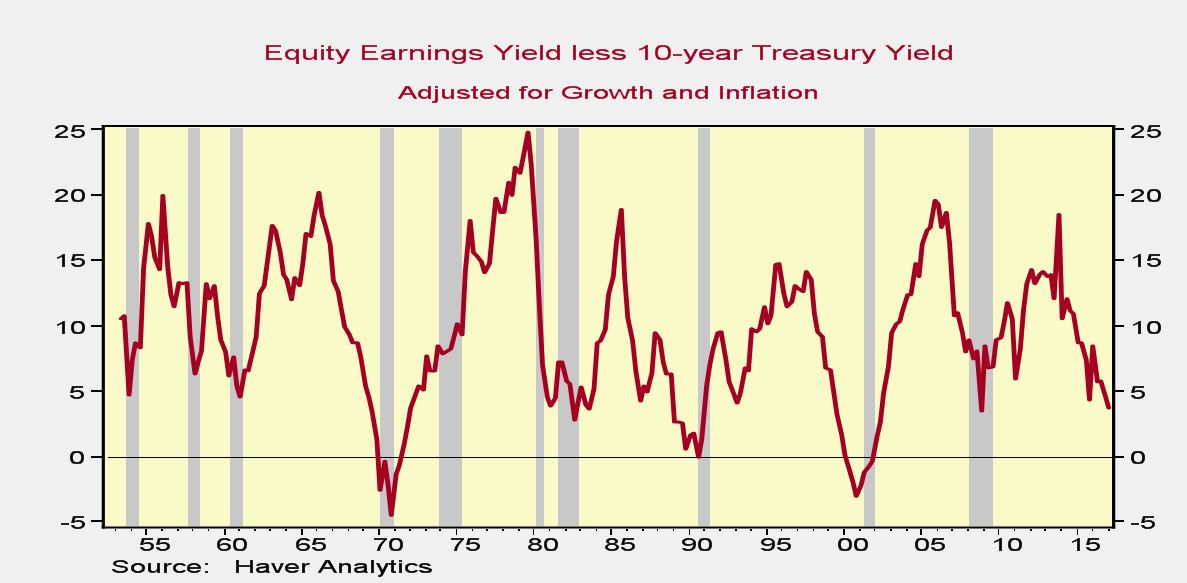
Consider the earnings yield over 10-year Treasury yield adjusted for inflation and growth (the Fed model corrected for its flaws). I have used NIPA earnings and equity market capitalization from the Flow of Funds. 


Visually, does this picture suggest any break to you? Contrast with the CAPE picture. Statistically too, the case for break in the 1990s is much less significant.

At the bottom of it, value guys want to believe that there is a bedrock relationship between earnings and valuations. And it appears that there was one for more than 300 years, according to this study. However, the study also suggests that the discount factor has become more dominant in the post WWII era. So, if it is different this time, that time started in 1945!

Profit Margins

There are a lot of misconceptions about profit margins. I would encourage you to read a longer piece I wrote with my colleagues at the Levy Forecasting Center. Briefly,

1. Often, people are looking at the wrong measure of margins--for instance, corporate profits as a share of GDP, when they should be looking at profits earned domestically as a share of GDP. the correct margin (the blue line below) is high but not off the charts.


2. Margins are bounded and cyclical but that does not mean they are mean-reverting. They can remain high for decades.

The bottom line is that mean-reversion based arguments are tricky. Use with caution. 

  Current Account Imbalances, Debt Buildup, and Instability Abstract: Orthodox trade theory focuses on the reallocation of real resources th...